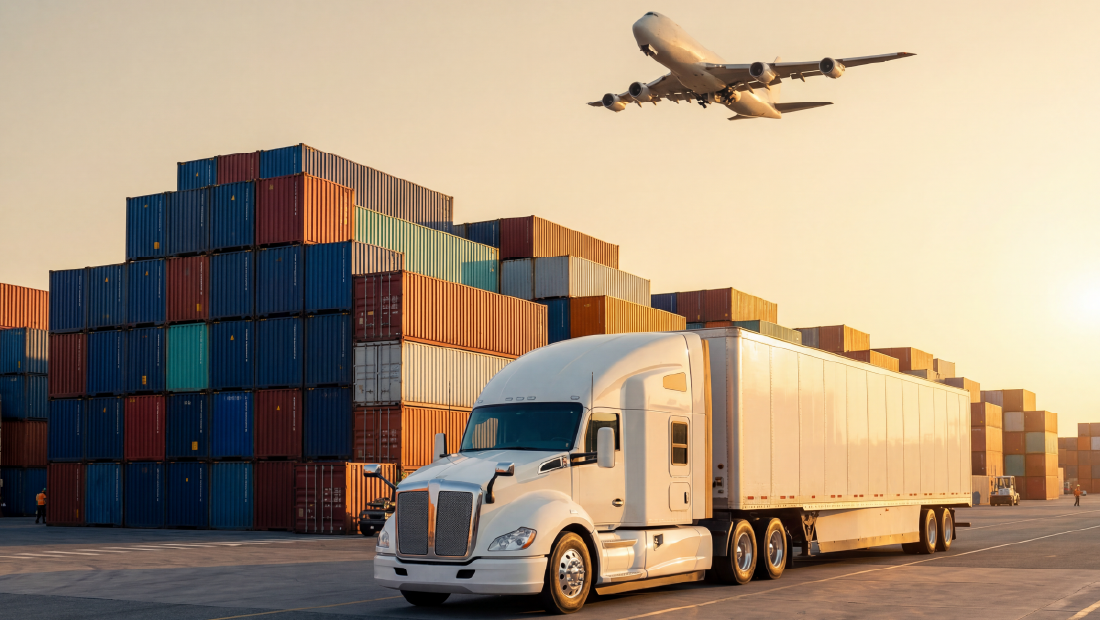
Air freight costs 4–12 times more than ocean freight per kilogram, but it’s the right call more often than shippers assume — not because speed is nice to have, but because the true cost of a shipment includes more than the freight invoice. This guide walks through the real 2026 numbers, the math for finding your own break-even point, and a decision framework you can apply to your next shipment.
Global logistics decisions rarely come down to “which mode is cheapest.” They come down to which mode is cheapest once you count inventory carrying cost, stockout risk, spoilage, and the tariff and customs landscape your goods actually move through. That’s the lens this guide uses.
What Is International Air Freight, and Where Does It Fit in Global Logistics?
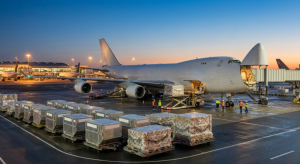
International air freight is the transport of goods by aircraft — either on dedicated freighters or in the belly holds of passenger planes — and it forms the fastest tier of the global logistics network alongside ocean, rail, and ground transport. It’s a small slice of global trade by volume but a disproportionately large slice by value, because the goods that move by air tend to be the most time-sensitive or valuable in the supply chain.
Air freight typically moves through one of three service tiers:
- Standard/consolidated air freight — Shares cargo space with other shippers; 5–7 day transit, lowest air rate.
- Standard air freight (direct) — 3–5 day transit on scheduled cargo or passenger-belly capacity.
- Express air freight — 1–3 day door-to-door service via carriers like DHL, FedEx, or UPS; costs 20–40% more than standard air.
- Charter air freight — On-demand aircraft for oversized, urgent, or high-value loads; the most expensive tier, often reserved for emergencies.
Ocean and ground freight sit at the other end of the spectrum: far cheaper per kilogram, but measured in weeks rather than days.
How Much Does Air Freight Actually Cost Compared to Ocean and Ground in 2026?
On a major lane like China to the US, air freight runs roughly $3.50–$7.50 per kg versus $0.20–$0.80 per kg for ocean freight — a 5-to-12x premium that buys you a delivery window measured in days instead of weeks. Ground freight sits in between on cost for regional and cross-border road lanes, but it only applies where a continuous road route exists.
| Mode | Typical cost per kg (2026) | Typical transit time | Best suited for |
|---|---|---|---|
| Ocean FCL (full container) | $0.20–$0.50/kg equivalent | 20–42 days door-to-door | Large volume, low urgency, price-sensitive goods |
| Ocean LCL (shared container) | $0.30–$0.90/kg equivalent | 25–40 days door-to-door | Smaller volume shipments not filling a full container |
| Ground freight (regional/cross-border) | Varies widely by distance and load | 1–7 days regionally | Nearby markets with road access (e.g., Canada-US, intra-EU) |
| Air freight, standard | $2.50–$6.00/kg | 3–7 days | Time-sensitive but not urgent cargo |
| Air freight, express | $5.00–$8.50/kg | 1–3 days | High-value, perishable, or deadline-critical shipments |
| Air freight, charter | $12.00–$25.00/kg | 1–2 days | Emergency replenishment, oversized or irreplaceable cargo |
Two pricing quirks catch out first-time shippers on both air and ocean freight:
- Chargeable weight — Airlines bill on whichever is greater: actual weight or volumetric (dimensional) weight, calculated as length × width × height (cm) ÷ 6,000. Light, bulky cargo like foam or textiles almost always gets billed on volume, not the scale.
- Peak season surcharges — Air rates can climb 20–40% above base rate during Q4 pre-holiday shipping and Chinese New Year production surges, so booking capacity 3–6 weeks ahead matters as much as the rate itself.
What’s the Break-Even Point Between Air and Ocean Freight?
The break-even point for most shipments sits around 500–1,000 kg or when cargo value exceeds roughly $15–$50 per kg — below that weight or above that value density, air freight’s speed premium usually pays for itself. Above that weight, on standard-value goods, ocean freight almost always wins on total landed cost.
Here’s a simplified way to run the math yourself:
- Get your chargeable weight — Compare actual weight to volumetric weight and use the higher figure.
- Price both modes — Multiply chargeable weight by the current per-kg rate for air and for ocean (LCL rates are usually quoted per cubic meter, so convert using 1 CBM ≈ 166.67 kg for air-equivalent comparison).
- Add the hidden costs on each side — Inventory carrying cost, warehousing, insurance, and stockout risk for ocean; fuel surcharges, handling, and customs clearance fees for air.
- Compare total landed cost, not just freight cost — The mode with the lower all-in number, including the cost of capital tied up in transit, wins.
Example: a 500 kg shipment of consumer electronics from China to the US West Coast. At $5/kg, air freight costs about $2,500 and lands in roughly a week. At $0.40/kg ocean-equivalent, sea freight costs about $200 but takes 25–35 days door-to-door. If that inventory carries a wholesale value that would otherwise sit idle for a month, or if a stockout during that month would cost more than the $2,300 freight difference, air wins even though it looks more expensive on the invoice.
A Faster Rule of Thumb: Freight Cost as a Share of Cargo Value
If you don’t want to run the full break-even math for every shipment, a simpler screening test is to check freight cost as a percentage of the cargo’s value. Air freight generally starts to make commercial sense once the air-ocean cost gap falls under roughly 15–20% of what the goods are worth — above that share, the speed premium usually isn’t paying for itself.
Why cost-multiple claims vary so widely. You’ll see air freight described as “60% more expensive than ocean” in one source and “4 to 12 times more expensive” in another. Both can be true — the multiple depends heavily on route, container fill rate, season, and whether the ocean comparison is FCL, LCL, or a small parcel. A near-full ocean container will show a much smaller air premium than a tiny LCL shipment compared against express air. Treat any single “X times more expensive” figure as directional, not a fixed constant, and always compare quotes on your actual route and volume.
When Is Air Freight Actually Worth the Extra Cost?
Air freight earns its premium when the cost of waiting is higher than the cost of flying — which is more often true than the sticker price suggests, especially for high-turnover or perishable inventory. The decision isn’t “can I afford air freight,” it’s “can I afford not to.”
Air freight is usually the right call when:
- The cargo is perishable or has a shelf-life clock running — pharmaceuticals, fresh produce, flowers, and some chemicals lose value every day they sit in transit.
- The shipment is high-value relative to its weight — consumer electronics, luxury goods, and precision components often clear the $15–$50/kg threshold where air’s speed offsets its cost.
- A stockout would cost more than the freight difference — lost sales, canceled orders, or contractual penalties for late delivery can dwarf a few thousand dollars in extra freight spend.
- The order is a rush replenishment — filling an unexpected demand spike or covering a production delay elsewhere in the chain.
- Cash-to-cash cycle time matters — faster delivery means faster payment collection and less capital tied up in transit inventory.
- Theft, damage, or handling risk is a concern — shorter transit times reduce the exposure window compared to weeks at sea.
Worth noting: air freight is not automatically the “safer” or “more reliable” default just because it costs more. Some experienced freight planners specifically caution against treating air as a default upgrade from ocean, since a poorly planned air shipment still carries disruption risk from capacity crunches, customs holds, and airport congestion — the premium buys speed, not a guarantee.
When Should You Choose Ocean or Ground Freight Instead?
Ocean or ground freight is the better choice whenever the goods are heavy relative to their value, the delivery date has real flexibility, and the business can plan around a multi-week lead time rather than reacting to one. This describes the majority of global trade by volume, which is why ocean freight still moves the overwhelming share of the world’s goods.
Choose ocean or ground freight when:
- Cargo is dense and low-value per kilogram — furniture, raw materials, bulk commodities, construction materials.
- You’re building inventory ahead of a known demand cycle rather than reacting to one.
- The shipment fills or nearly fills a full container, where ocean’s per-unit economics are hard to beat.
- A regional road lane exists and transit time of a few days is acceptable — this is common for Canada-US and intra-EU shipments.
- Budget predictability matters more than speed, since ocean rates are generally steadier than air’s peak-season swings.
How Are Current Trade Disruptions Affecting the Air vs. Ocean Decision?
Two forces are actively pushing more cargo toward air freight in 2026: continued Red Sea rerouting adding 10–14 days to some ocean lanes, and shifting US tariff policy that’s prompting businesses to front-load shipments ahead of rate changes. Neither of these is a permanent state of the market, but both are live factors worth checking before you commit to a mode.
- Red Sea disruptions — Ongoing rerouting around the Cape of Good Hope continues to add transit time and absorb ocean container capacity on Asia-Europe and Asia-US East Coast lanes, which has tightened ocean schedules and made air freight comparatively more attractive on time-sensitive orders.
- Tariff-driven front-loading — Shifts in US tariff policy have periodically triggered rushes to get goods across the border ahead of rate changes, which can spike demand — and prices — on both air and ocean capacity in short bursts.
- Fuel and surcharge volatility — Fuel surcharges apply on top of base air rates and can move independently of the headline per-kg price, so always confirm the all-in rate before comparing modes.
If your shipments cross the US-Canada border specifically, note that mode choice doesn’t change your customs obligations — duty and documentation requirements apply the same way whether goods arrive by air, ocean, or truck.
A Step-by-Step Framework for Choosing Your Freight Mode
- Calculate chargeable weight for the shipment using actual vs. volumetric weight.
- Get current quotes for air (standard and express) and ocean (FCL or LCL, as applicable) on your specific lane.
- Estimate your true deadline — not the date you’d prefer, but the date after which the shipment stops being useful or starts costing you sales.
- Add carrying cost and risk to the ocean quote, and add fuel surcharge, handling, and customs fees to the air quote.
- Compare total landed cost, not sticker price, and choose the lower number for shipments where either mode would arrive in time.
- Reassess per shipment, not per contract — the right mode can change shipment to shipment based on weight, value, deadline, and current capacity conditions.
- Build in a buffer for peak season and disruption windows by booking capacity 3–6 weeks ahead when your calendar allows it.
Hidden Costs That Change the Air vs. Ocean Math
- Fuel surcharges — Applied on top of the base air rate and can shift the effective per-kg cost by a meaningful margin.
- Customs clearance fees — Apply at both ends regardless of mode, but express air carriers often bundle this into a single door-to-door price.
- Drayage and last-mile trucking — Ocean freight in particular carries added cost and time for moving containers from port to warehouse.
- Inventory carrying cost — The capital tied up in a slow-moving ocean shipment has a real cost, even if it never appears as a line item on the freight invoice.
- Insurance — Longer transit times and more handling touchpoints on ocean freight can mean higher insurance costs relative to cargo value.
Frequently Asked Questions
Is air freight always more expensive than ocean freight?
Per kilogram, yes — air freight typically costs 4 to 12 times more than ocean freight. But once you add inventory carrying cost, stockout risk, and insurance, the total landed cost gap narrows significantly for high-value or time-sensitive goods, and air can come out ahead overall.
What’s the minimum shipment size for air freight to make sense?
There’s no strict minimum, but air freight tends to make the most financial sense under roughly 500–1,000 kg or when cargo value exceeds about $15–$50 per kilogram. Above that weight on standard-value goods, ocean freight is almost always cheaper on a total-cost basis.
How long does international air freight actually take?
Standard air freight typically takes 3–7 days airport-to-airport, with express services at 1–3 days and charter service in 1–2 days. Add 1–2 days for pickup and delivery and 1–2 days for customs clearance at each end for a realistic door-to-door estimate.
What is volumetric weight, and why does it matter for air freight cost?
Volumetric (dimensional) weight is calculated from a shipment’s dimensions — length × width × height in centimeters, divided by 6,000 — and airlines charge based on whichever is higher, actual weight or volumetric weight. Light, bulky cargo like foam packaging or textiles is usually billed on volume rather than weight, which can make air freight costlier than expected for low-density goods.
Does choosing air freight instead of ocean freight change my customs or duty obligations?
No. Duty rates, required documentation, and customs clearance obligations are generally determined by the goods themselves and the trade agreement or tariff rules that apply — not by the transport mode. Air freight can sometimes clear customs faster in practice, but it doesn’t reduce or eliminate duty owed.
Why are ocean freight transit times so much longer than air freight?
Ocean freight transit time is driven by vessel speed, port congestion, and routing — a container from Shanghai to Los Angeles typically takes 14–18 days port-to-port, or longer to the US East Coast via the Panama Canal, plus several more days for customs clearance and inland trucking. Current Red Sea rerouting has added further delay to some Asia-Europe and Asia-US East Coast lanes.
Should I use the same freight mode for every shipment, or switch based on need?
Most experienced shippers vary mode by shipment rather than committing to one mode for everything, since the right choice depends on that specific shipment’s weight, value, deadline, and current market capacity. Treating mode selection as a per-shipment decision — not a standing policy — typically produces the lowest total logistics cost over time.
Is air freight 60% more expensive than ocean, or up to 12 times more?
Both figures show up because the multiple depends on the shipment being compared. A well-filled ocean container against standard air freight might show a 60% gap, while a small parcel compared against express or charter air can easily reach 10–12 times the cost. Always compare quotes for your specific weight, volume, and service tier rather than relying on a single industry-wide multiple.
Is air freight riskier or safer than ocean freight for fragile goods?
Air freight generally sees less handling and a shorter transit window, which tends to reduce damage and theft risk compared to weeks at sea. That said, air shipments still face their own disruption risks — capacity shortages, customs delays, and airport congestion — so speed doesn’t automatically mean a risk-free shipment.