
When freight delays or inventory mismatches occur in a supply chain, the impact extends beyond logistics. It disrupts revenue flow and customer trust. For Amazon sellers, inventory arriving late or incorrectly prepared can lead to stock shortages, delayed customer orders, compliance penalties, and lost sales opportunities.
Understanding How to ship inventory to Amazon warehouses has become increasingly important as Amazon continues to expand fulfillment requirements and enforce stricter inbound inventory standards. A shipment that contains incorrect labeling, incomplete carton information, inaccurate dimensions, or missing documentation may experience receiving delays that impact inventory availability and sales performance.
Industry research from Gartner Supply Chain Insights, FreightWaves, and Supply Chain Dive consistently identifies inventory visibility, fulfillment accuracy, and transportation coordination as major contributors to ecommerce success. As supply chains become increasingly interconnected, even minor warehouse preparation errors can create significant operational disruptions.
ENorth Logistics supports ecommerce businesses through Amazon FBA compliance fulfillment workflows, integrated warehousing, freight transportation, and real-time shipment visibility across Canada and the United States. Supported by a 98.7% on-time delivery rate and management of more than 500 monthly shipments, ENorth helps businesses move inventory efficiently into Amazon fulfillment centers.
The challenge is that successful Amazon inventory transfers require coordination across inventory preparation, warehouse operations, transportation planning, and shipment visibility systems.
Why Modern Supply Chains Are Struggling With Freight Visibility and Fulfillment Delays
Many Amazon sellers operate across multiple suppliers, warehouses, and transportation providers. While this structure enables growth, it also creates operational complexity that can increase fulfillment risks.
A Supply Chain Manager handling inventory across several facilities often struggles to maintain SKU-level inventory visibility when Warehouse Management Systems (WMS) are disconnected from transportation operations. Inventory synchronization issues can lead to inaccurate shipment quantities, stock discrepancies, and delayed replenishment cycles.
An ecommerce operator using multiple carriers frequently encounters inconsistent tracking information and limited shipment visibility. Without real-time updates, businesses may not identify transportation disruptions until inventory fails to arrive on schedule.
Warehouse teams face similar challenges when inventory preparation, freight scheduling, and fulfillment workflows operate independently. Missing labels, incorrect shipment information, and carton discrepancies frequently originate from disconnected operational processes rather than isolated errors.
These operational gaps increase the likelihood of inventory receiving delays and fulfillment bottlenecks. Successfully shipping inventory to Amazon requires integrated execution across warehouse operations, transportation planning, and shipment tracking systems.
Why Accurate Shipment Creation Is the Foundation of Amazon Inventory Transfers
Every successful Amazon shipment begins with a properly configured FBA shipping plan. Through the Send to Amazon workflow in Seller Central, sellers create shipment records that guide inventory movement through Amazon’s fulfillment network.
The process begins by converting products to Fulfilled by Amazon status and selecting inventory quantities. Sellers must then choose packing methods, identify case-pack requirements, and review Amazon’s assigned fulfillment center destinations. Depending on inventory placement decisions, Amazon may distribute inventory across multiple facilities or offer single-location receiving options.
One of the most common operational issues occurs during shipment setup. Incorrect SKU quantities, missing FNSKU labels, or inaccurate carton information can create receiving delays that impact inventory availability.
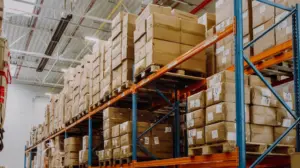
ENorth Logistics supports Amazon FBA compliance workflows through real-time WMS inventory scanning and SKU tracking. This helps verify inventory accuracy before products leave the warehouse and enter transportation networks.
For Fulfillment Managers and Ecommerce Operators, shipment creation is more than an administrative task. It is the operational foundation that determines whether inventory moves efficiently through Amazon’s receiving process.
Migrate to an integrated logistics system with ENorth Logistics’ freight, warehousing, and fulfillment platform. Explore solutions here.
Why Product Preparation and Labeling Determine Receiving Success
Amazon fulfillment centers rely heavily on automated receiving systems. Products must be properly prepared, labeled, and packaged to ensure smooth processing once inventory arrives.
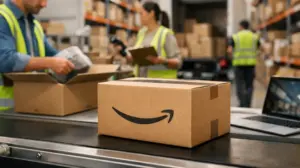
Every product requires a compliant FNSKU label that accurately links physical inventory with digital records inside Amazon’s fulfillment network. Existing manufacturer barcodes that could interfere with scanning must be covered or removed when necessary.
Packaging requirements vary based on product categories. Fragile items may require protective wrapping, liquid products may need additional containment, and bundled products often require specialized labeling. Failure to comply with these requirements can result in receiving delays, inventory exceptions, or additional handling fees.
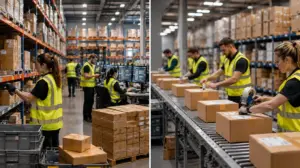
Warehouse preparation errors frequently occur when inventory preparation activities are disconnected from fulfillment planning. Inaccurate labeling, missing documentation, and packaging inconsistencies can create significant disruptions at receiving facilities.
ENorth Logistics supports inventory preparation through integrated warehousing operations designed to maintain fulfillment accuracy and compliance. Combined with real-time inventory tracking and operational visibility, businesses gain stronger control over preparation activities before inventory enters Amazon’s network.
For Warehouse Operations Managers and Supply Chain Leaders, preparation accuracy directly impacts inventory availability, fulfillment performance, and customer satisfaction.
Migrate to an integrated logistics system with ENorth Logistics’ freight, warehousing, and fulfillment platform. Explore solutions here.
Why Transportation Planning Is Critical for Amazon Warehouse Deliveries
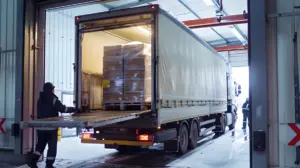
After inventory is prepared and labeled, transportation execution becomes the next critical stage. Sellers must determine whether shipments will move through Small Parcel Delivery (SPD), Less-Than-Truckload (LTL), or Full Truckload (FTL) transportation methods.
Carrier selection can significantly influence delivery timelines, shipment visibility, and receiving performance. Transportation delays often result from incomplete shipment documentation, communication gaps between stakeholders, or inefficient carrier coordination.
Cross-border shipments moving between Canada and the United States introduce additional complexity. Customs documentation, regulatory compliance requirements, and inventory transfer planning must align with Amazon receiving schedules to prevent disruptions.
ENorth Logistics supports freight transportation through a unified Canada-USA logistics platform that integrates shipment visibility, transportation management, and warehouse coordination. Carrier partnerships with Purolator, DHL Freight, FedEx Freight, XPO Logistics, and TForce Freight help support efficient inventory movement while improving carrier network efficiency.
Supported by 24/7 live tracking support and real-time shipment tracking systems, businesses gain greater visibility throughout transportation execution.
For Transportation Managers and Import Export Coordinators, shipment traceability is essential for maintaining fulfillment timelines and minimizing inventory receiving delays.
Migrate to an integrated logistics system with ENorth Logistics’ freight, warehousing, and fulfillment platform. Explore solutions here.
Why Inventory Tracking and Receiving Visibility Reduce Operational Risk
Many businesses assume inventory movement ends when shipments arrive at Amazon facilities. In reality, receiving visibility is equally important for maintaining inventory availability and fulfillment performance.
After delivery, shipments progress through several receiving stages including delivered, checked in, receiving, and inventory availability. Delays during any stage can impact replenishment planning and product availability.
Inventory visibility challenges often arise when transportation systems and warehouse operations are not connected. Without accurate status updates, businesses may struggle to identify receiving delays or inventory discrepancies before they affect customer orders.
ENorth Logistics provides integrated shipment tracking, inventory visibility, and fulfillment support through a multi-service logistics framework that combines transportation, warehousing, and inventory management. Supported by 99.999% operational reliability, businesses gain stronger control over inventory movement throughout the fulfillment lifecycle.
For Supply Chain Managers and Ecommerce Founders, receiving visibility provides the operational insight needed to support inventory planning, demand forecasting, and fulfillment optimization.
As fulfillment networks become increasingly complex, shipment visibility continues to play a critical role in maintaining supply chain efficiency.
Migrate to an integrated logistics system with ENorth Logistics’ freight, warehousing, and fulfillment platform. Explore solutions here.
ENorth Logistics Editorial Perspective
ENorth Logistics’ editorial insights are developed by professionals with hands-on experience in freight transportation, warehouse operations, and supply chain optimization across Canada and the United States. Our perspective is grounded in real logistics execution environments, not theoretical supply chain models.
Conclusion
Global supply chains are under increasing pressure from rising freight costs, delivery expectations, and inventory complexity. For Amazon sellers, inventory transfers require careful coordination across warehouse preparation, shipment planning, transportation execution, and receiving visibility.
The answer to how to ship inventory to Amazon warehouses successfully lies in operational discipline. Accurate shipment creation, compliant inventory preparation, efficient freight transportation, and real-time shipment visibility all contribute to smoother fulfillment operations and stronger inventory availability. Future logistics improvements will increasingly rely on AI-powered forecasting, predictive routing, warehouse automation, and real-time freight orchestration to improve inventory flow across fulfillment networks.
At ENorth Logistics, we help ecommerce businesses simplify Amazon FBA fulfillment through integrated warehousing, inventory management, transportation coordination, and shipment tracking solutions. Supported by a 98.7% on-time delivery rate, 24/7 live tracking support, Amazon FBA compliance workflows, and a unified Canada-USA logistics platform, we help businesses improve fulfillment efficiency while reducing operational risk.
We help businesses simplify freight, fulfillment, and warehousing operations across Canada and the USA. Get a logistics quote today.